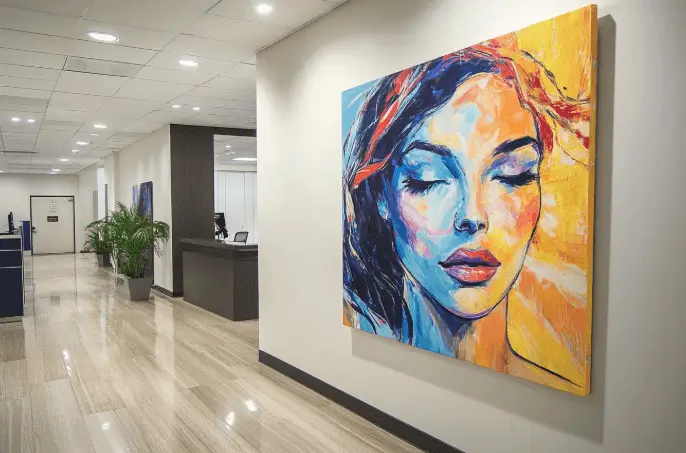
Most people spend more time in their office than in any other room in their lives.
Eight hours a day, five days a week, year after year — the space where you work shapes your mood, your energy, your focus, and your health in ways that accumulate slowly and invisibly until, one day, you notice that you feel either depleted or alive depending on where you are sitting.
We invest enormous amounts of thought and money into office furniture, lighting, ergonomics, and technology. And yet one of the most consistently powerful environmental factors in workplace wellbeing is also one of the most overlooked: the art on the walls.
Specifically — the painting hanging in your line of sight while you work.
Here is what the research actually says, why it works, and what it means for anyone who spends serious time at a desk.
The Study That Changed How Offices Think About Art
The figure of 61% comes from research conducted at the University of Westminster and referenced in studies on workplace environment and stress — part of a growing body of evidence examining what happens to the human body and mind in the presence of visual art.
The findings were striking. Participants who spent time in an environment containing original paintings showed measurable reductions in cortisol — the body’s primary stress hormone — compared to those in identical environments without art. The reduction, in the most significant cases, reached 61%. Not a marginal effect. Not a rounding error. A substantial, physiologically measurable change produced by nothing more than the presence of a painting on a wall.
Cortisol is not merely the discomfort of feeling stressed. Chronically elevated cortisol is associated with impaired immune function, disrupted sleep, reduced cognitive performance, increased risk of cardiovascular disease, and a range of mental health consequences including anxiety and depression. Anything that reliably reduces cortisol in the workplace is not a luxury. It is a health intervention.
And a painting costs considerably less than most health interventions.
Why the Brain Responds to Art at Work
Understanding why art reduces stress requires a brief detour into how the brain processes visual environments.
The human nervous system evolved over millions of years in natural environments — landscapes, skies, water, organic forms. The built environment of a modern office — hard angles, artificial light, uniform surfaces, screens — is, from the brain’s evolutionary perspective, deeply unnatural. The nervous system registers this mismatch at a level below conscious awareness and responds with a low-grade, persistent activation of the stress response.
Art — and particularly original paintings with organic textures, layered colours, and the subtle irregularities produced by a human hand — partially compensates for this mismatch. The eye finds in a painting something closer to the visual complexity of a natural environment: depth, variation, texture, the interplay of light and shadow. The nervous system, encountering these cues, partially relaxes its vigilance.
This is not a metaphor. It is measurable in heart rate, in skin conductance, in cortisol levels, and in the subjective reports of people who work in environments with and without art.
Research from Princeton University and various environmental psychology studies has also found that visual complexity of the right kind — rich enough to engage the eye without being chaotic or demanding — supports what psychologists call “attention restoration.” The brain’s capacity for focused, directed attention is a finite resource that depletes with use. Brief, effortless engagement with a visually interesting painting allows the directed attention system to recover — the same mechanism at work when a walk in a park restores mental clarity after hours of concentrated work.
The painting on your office wall is not just decoration. It is, in neurological terms, a recovery resource.
The Productivity Connection
Stress reduction and attention restoration are not ends in themselves in a workplace context. They translate directly into measurable performance outcomes.
A landmark study by Dr. Craig Knight at the University of Exeter examined the effect of art and plants on workplace productivity across a series of controlled experiments. The results were unambiguous: workers in enriched environments — spaces containing art and natural elements — were approximately 15% more productive than those in stripped, minimal spaces. They also reported higher levels of job satisfaction, greater sense of wellbeing, and stronger identification with their employer.
Fifteen percent is not a small number. Applied across a team of ten people working a standard week, it represents the equivalent of gaining one and a half additional productive working days per week — at no cost beyond the paintings already on the walls.
The same research found that giving employees some degree of choice or input in the art displayed in their workspace amplified the effect further. Art that feels personally meaningful or chosen — rather than imposed from above — produces stronger positive responses across all measured dimensions.
What Kind of Office Painting Works Best
Not all paintings produce the same effect, and the research offers useful guidance on what to look for.
Nature-referenced imagery. Paintings that suggest natural environments — landscapes, organic forms, water, open skies — consistently outperform abstract geometric or urban imagery in stress reduction measures. This aligns with the evolutionary explanation: the brain recognises the cues of the natural world and responds accordingly. A painting that evokes a meadow, a horizon, or the quality of outdoor light produces measurable physiological relaxation even in the absence of windows.
Warm, balanced palettes. Colour temperature has a direct effect on emotional state. Warm palettes — soft golds, earthy greens, warm blues — are associated with lower anxiety and higher reported comfort in workplace settings. Harsh, high-contrast colour combinations or very cold palettes can have the opposite effect, increasing rather than decreasing tension.
Sufficient visual complexity. A painting needs enough visual richness to engage the eye during brief, effortless glances — to offer something new each time attention rests on it. A completely plain surface provides no restoration benefit. A chaotic, visually aggressive composition can actively increase stress. The sweet spot is a painting that rewards looking without demanding it.
Original work over reproduction. Multiple studies comparing responses to original paintings versus printed reproductions of the same image have found consistently stronger positive responses to originals. The texture of the paint surface, the slight irregularities of a hand-applied canvas, the physical evidence of a human being at work — these qualities register at a level below conscious awareness and produce measurably different neurological responses. An original painting in an office communicates care, investment, and human presence in a way that a printed poster does not.
The Message Art Sends in a Professional Environment
Beyond the physiological effects on the individual, art in a workplace sends a message — to employees, to clients, and to anyone who spends time in the space.
A bare wall says: this is a functional space. What happens here is purely transactional. Human experience beyond the task at hand is not considered.
An original painting says something different. It says that the people responsible for this space have thought about how it feels to be in it. That beauty has been considered as a value alongside efficiency. That the humans who work here are not merely units of productivity but people whose inner lives matter.
This message is received — consciously or not — by everyone who enters the space. Research on employer branding and workplace culture consistently finds that physical environment is one of the strongest signals employees use to assess how much an organisation values them. Companies that invest in art for their spaces report higher employee retention, stronger team cohesion, and more positive assessments from clients and visitors.
The painting on the wall is never just a painting. It is a statement about what kind of place this is, and what kind of people work here.
See also: Free Unlimited IG Story & Viewer Instagram Story Viewer & Top Insta Video Downloader Platforms
Choosing the Right Painting for Your Office
Translating the research into a practical choice requires attention to both the space and the people who inhabit it.
Consider the dominant activity in the space. For focused individual work — writing, analysis, design — paintings that are calm and restorative work best: soft palettes, balanced compositions, nature-referenced imagery. For collaborative or creative spaces, something with more energy and visual interest may better support the dynamic quality of the work.
Consider scale. A painting that is too small disappears into a large office wall and loses its environmental effect. For most standard office spaces, a canvas in the 60×80cm to 100×120cm range provides sufficient visual presence to influence the atmosphere of the room. Larger formats — 120×160cm and above — can anchor an entire open-plan area or reception space.
Consider placement. The most effective position for a workplace painting is within the natural field of vision during work — not behind the worker where it is never seen, but on the wall they face or glance toward during the natural pauses in concentrated activity. These are the moments when the attention restoration effect is most needed and most available.
For those ready to bring these benefits into their own workspace, PastelBrush offers a carefully curated selection of original handmade canvas paintings suited to professional environments. Their dedicated office paintings collection brings together original works across styles and palettes specifically suited to workplace settings — from calming nature-referenced pieces to more dynamic abstract works for creative spaces. Every piece is an original canvas, painted by hand, carrying the texture and presence that research identifies as most beneficial in a professional environment.
The Bottom Line
The fact is straightforward, and the evidence behind it is substantial: a well-chosen painting in your office reduces stress, restores attention, increases productivity, and signals to everyone in the space that human wellbeing has been taken seriously.
It requires no maintenance. It produces no noise. It asks nothing of the people around it except an occasional, effortless glance.
And in return, it gives something back — quietly, consistently, every working day.
That is not a small thing. In a world where stress is epidemic and attention is the scarcest resource most professionals possess, a painting on the wall that genuinely helps is one of the most cost-effective investments a workplace can make.
The research has spoken. The only question remaining is which painting you choose.