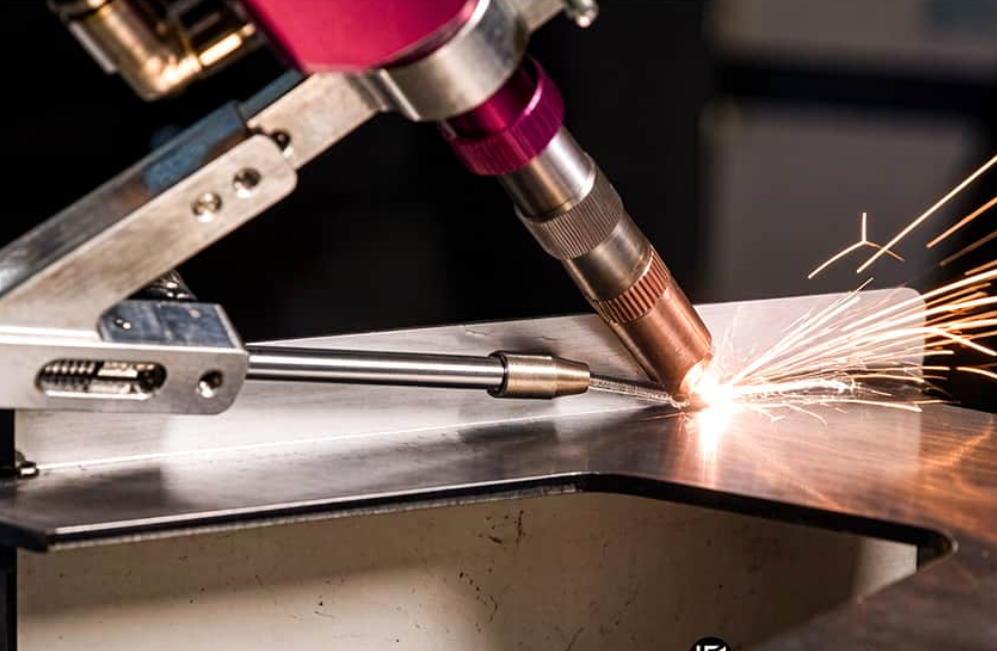
Manufacturers working with metal assemblies are facing a difficult balance between precision, production speed, repeatability, and cost control. As products become more compact and component designs become more intricate, even small variations in a welded joint can affect the appearance, dimensions, strength, or later assembly stages. Traditional welding remains highly useful, but repetitive production can introduce differences in torch movement, heat application, positioning, and timing. Precision laser welding offers another approach by concentrating energy into a tightly controlled area while automated equipment manages the movement of the welding head.
A robot laser welding machine combines a programmable robotic arm with a laser welding system to create a repeatable joining process. Instead of depending entirely on manual movement, manufacturers can establish defined welding paths and reproduce them across multiple components. This can be especially valuable when the same joint needs to be produced hundreds or thousands of times. The robot handles repetitive positioning while engineers and operators remain responsible for programming, parameter development, quality control, maintenance, and process optimization.
The significance of this technology goes beyond simply replacing a person holding a welding torch. Laser welding introduces a different way of controlling heat, movement, and production consistency. Because the laser can deliver energy to a concentrated location, manufacturers can develop processes around specific materials, thicknesses, joint geometries, and production requirements. When this is combined with robotic positioning, monitoring systems, suitable fixtures, and proper process validation, laser welding can become part of a much broader strategy for producing consistent metal assemblies.
Why Concentrated Laser Energy Changes Metal Joining
Laser welding differs from many conventional welding methods because the energy can be focused into a relatively small area. This allows manufacturers to work with a highly concentrated heat source rather than distributing as much thermal energy across the surrounding material. The resulting heat profile can be particularly valuable for applications where distortion, appearance, and dimensional accuracy are important.
The exact behaviour of the weld depends on factors such as material composition, thickness, laser power, focal position, travel speed, joint design, and surface condition. There is no universal laser setting that works for every application. Engineers therefore need to develop parameters around the specific assembly instead of assuming that higher laser power automatically means better results.
See also: The Role of Technology in Scientific Research
Repeatability Becomes a Production Advantage
A major reason manufacturers turn toward robotics is the ability to reproduce a programmed movement consistently. A skilled welder can produce excellent results, but repetitive work can become physically demanding and naturally introduces opportunities for variation over long production runs.
Once a robotic welding process has been properly programmed and validated, the same movement can be repeated across a large number of components. This can help manufacturers establish a more predictable process, particularly when component geometry remains consistent from one production cycle to another.
Complex Assemblies Require Controlled Movement
Modern metal products are rarely made from simple straight joints alone. Components can contain curved seams, narrow gaps, multiple joining points, and difficult angles. Reaching these locations manually while maintaining the same welding position throughout a production run can be challenging.
Robotic positioning gives manufacturers greater control over the path followed by the welding head. The robot can be programmed to approach a joint from a particular angle, maintain a defined travel path, and repeat the sequence for subsequent components. This makes automation particularly attractive for products where consistency is as important as welding speed.
Heat Management Can Affect Dimensional Accuracy
One of the biggest concerns in metal fabrication is unwanted thermal distortion. When material is exposed to excessive or poorly controlled heat, it can expand, contract, deform, or develop other changes that affect the finished assembly.
The concentrated nature of laser energy gives manufacturers greater control over where heat is introduced. For suitable applications, this can help limit unnecessary thermal exposure around the weld area. However, the final outcome still depends on process parameters, material characteristics, joint design, and cooling behaviour.
Faster Production Is Only One Part of the Benefit
It is easy to describe automation simply as a way to make welding faster, but productivity has several dimensions. A process can improve output not only by reducing welding time but also by minimizing unnecessary handling, reducing variation, and limiting rework.
When a robotic welding cell is integrated into a larger production line, components can move through different stages with fewer manual interruptions. Welding can become part of a coordinated sequence involving positioning, inspection, material handling, and downstream assembly. This can make the entire manufacturing workflow more efficient rather than merely increasing the speed of one operation.
Material Characteristics Must Guide Laser Settings
Different metals absorb and conduct laser energy differently. Reflective materials, highly conductive alloys, thin sheets, and thicker sections can all require different process strategies. Surface condition can also influence how consistently energy is absorbed by the workpiece.
For this reason, manufacturers need to test welding parameters before committing to full-scale production. Power, speed, focus, shielding conditions, beam characteristics, and joint preparation may all require adjustment. Proper process development is essential because the quality of the final joint depends on how these variables interact.
Robotic Automation Reduces Repetitive Physical Work
Repetitive welding can place physical demands on workers, particularly when the same posture or movement has to be maintained for extended periods. Robotic systems can take responsibility for predictable movement while human workers focus on tasks requiring technical judgment.
This does not remove skilled workers from the process. Instead, it can shift their responsibilities toward programming, setup, parameter development, inspection, troubleshooting, and preventive maintenance. The most effective automated welding environments combine robotic repeatability with human experience.
Where Precision Laser Welding Fits Best
Laser welding can be useful across industries where controlled joining and repeatable production are important.
Typical applications may include:
- Automotive components
- Precision metal assemblies
- Electronics housings
- Battery-related components
- Medical equipment
- Aerospace parts
- Industrial machinery
- Stainless-steel products
- Consumer hardware
- High-volume fabricated components
The suitability of laser welding depends on material, thickness, joint configuration, production volume, required weld characteristics, and the level of automation available within the facility.
Fixtures Are Just as Important as Robot Accuracy
A highly accurate robotic arm cannot compensate for a component that is positioned incorrectly. Fixtures therefore play a critical role in maintaining consistency. Parts need to remain securely positioned so that the programmed welding path corresponds with the actual joint.
Poor fixture design can create problems even when the laser and robot are operating correctly. Small shifts in component position can change the distance between the laser and material or cause the beam to move away from the intended seam. Reliable fixtures help the automated system reproduce the same welding conditions from one cycle to the next.
Quality Control Cannot Be Left to Automation Alone
Automation can repeat a process consistently, but consistency does not automatically mean correctness. If an incorrect welding parameter is programmed into the system, the same problem may be reproduced across many components.
Manufacturers therefore need appropriate inspection and monitoring procedures. Depending on the application, this may involve visual inspection, dimensional checks, weld monitoring, destructive testing, or other quality-assurance methods. Early detection of process changes can prevent a small problem from becoming a large production issue.
Why Monitoring Is Becoming More Valuable
Modern production environments increasingly rely on data to understand how equipment is performing. Robotic welding systems can potentially provide information related to cycle times, production counts, equipment status, maintenance requirements, and process conditions.
This information can help engineers identify recurring problems and understand where production delays are occurring. Instead of waiting for equipment failure or quality complaints, manufacturers can use process information to support preventive maintenance and continuous improvement.
One Automated Welding Cell Can Support a Larger Workflow
A robotic laser welding system does not have to operate independently. It can potentially be connected with conveyors, material-handling equipment, inspection systems, sensors, and production software.
This kind of integration can reduce manual transfers between production stages. Components can be positioned, welded, inspected, and moved onward according to a structured sequence. For high-volume production, this creates opportunities to reduce handling time while improving visibility into the manufacturing process.
What Manufacturers Should Evaluate Before Buying
Choosing automated laser welding equipment requires more than comparing laser power or robot specifications. The complete production environment needs to be considered.
Important factors include:
- Material type and thickness
- Required weld penetration
- Joint design
- Production volume
- Robot reach
- Positioning accuracy
- Laser source and power
- Fixture requirements
- Safety enclosure
- Fume extraction
- Programming system
- Quality monitoring
- Maintenance requirements
- Technical support
- Future production requirements
A system should be selected according to the actual manufacturing problem it needs to solve. A powerful machine that is poorly matched to the material or joint geometry may provide less value than a properly configured system designed around the application.
Why a Robot Laser Welding Machine Can Support Consistent Production
The real value of a robot laser welding machine becomes clearer when it is viewed as part of an entire manufacturing process. The robot provides controlled movement while the laser supplies concentrated energy to the intended joint. Together, they can create a repeatable process for applications where weld positioning, appearance, thermal control, and production consistency are important.
This approach can also help reduce unnecessary variation between individual components. Once the process has been developed and validated, programmed movement can be reproduced repeatedly without the physical fatigue associated with performing the same welding motion manually. The result is not guaranteed perfection, but it can provide a stronger foundation for consistent production.
Maintenance Determines Long-Term Reliability
Automated welding equipment still requires regular maintenance. Optical components, protective windows, laser systems, robotic joints, fixtures, extraction equipment, and other components can gradually experience wear or contamination.
Preventive maintenance helps manufacturers identify problems before they create unexpected downtime. Cleaning optical components, checking positioning accuracy, inspecting fixtures, and monitoring equipment condition can all contribute to stable operation.
Ignoring maintenance can undermine the advantages of automation. Even a highly sophisticated welding cell depends on properly functioning mechanical, optical, electrical, and software components.
Training Remains Essential in an Automated Factory
Robotic welding does not eliminate the need for knowledgeable personnel. In many cases, automation increases the importance of technical training because workers need to understand programming, process parameters, safety procedures, inspection requirements, and troubleshooting.
Operators should know how to respond when the robot reports an error, when weld quality changes, or when a component is not positioned correctly. Engineers also need to understand how material characteristics and process parameters interact. Human expertise remains an important part of successful automation.
Final Thoughts
Precision laser welding is becoming increasingly relevant as manufacturers look for ways to produce metal assemblies with greater repeatability and controlled heat input. The combination of focused laser energy and programmable robotic movement provides a powerful foundation for applications where traditional manual variation can become difficult to manage at production scale.
The strongest results come when the technology is treated as part of a complete manufacturing system rather than as an isolated welding machine. Laser parameters, robot movement, fixtures, material preparation, inspection, safety equipment, maintenance, and operator training all contribute to the final outcome. When these elements are properly coordinated, manufacturers can build a more predictable production process.
The future of automated welding is therefore not simply about making robots work faster. It is about creating manufacturing processes that can be measured, repeated, monitored, and improved. As product designs become more demanding and production environments become increasingly automated, precision laser welding can provide manufacturers with another practical way to improve consistency while keeping complex metal assembly operations under tighter control.