Construction teams rarely have the luxury of working with ground that behaves exactly as expected. A foundation excavation may encounter unexpected layers, a retaining wall project may run alongside existing structures, or an underground excavation may reveal fractured material that was not obvious during the early planning stages. These situations make reinforcement more than a matter of choosing a strong steel component. The installation process itself becomes an important part of the engineering strategy.
A hollow anchor bar provides a practical way to combine several stages of ground reinforcement within a coordinated installation process. Its internal passage can be used for drilling and grout delivery, while the bar remains within the ground as part of the completed reinforcement system. This arrangement can change the way crews approach sites where conventional drilling and anchoring procedures are difficult to manage.
The significance of this technology is therefore not limited to the steel element itself. Its value also comes from the way it can influence site logistics, drilling sequences, access requirements, and reinforcement installation. When these factors are considered together, hollow bar systems can become useful tools for projects where ground conditions and working space create additional challenges.
Moving Beyond a Separate Installation Sequence
Many conventional reinforcement methods rely on a sequence in which a hole is drilled, the drilling equipment is withdrawn, and a separate reinforcement element is inserted. That approach can be effective in stable formations, but it can become less convenient when the drilled opening does not remain intact.
A self-drilling hollow bar can change this sequence because the drilling element and reinforcement remain connected during installation. The bar advances as drilling progresses, which means there is less dependence on preserving an empty borehole between drilling and reinforcement placement.
This can be particularly relevant when construction teams are working against difficult ground behavior. Rather than adding another operation to recover or stabilize a problematic borehole, the installation process can be designed around continuous advancement of the anchor assembly.
See also: The Role of Technology in Smart Farming
A Different Approach to Site Logistics
Construction efficiency is often influenced by the movement of equipment as much as by the speed of individual operations. Every additional machine, material transfer, and installation stage creates another logistical requirement.
A hollow bar system can consolidate parts of the drilling and anchoring workflow. The same basic reinforcement element can be used during drilling and then retained in the ground for grouting and structural support.
This can simplify material handling on sites where storage space is limited. It can also reduce the need to move separate reinforcement components into position after drilling has already been completed, depending on the selected installation system.
When Working Space Becomes a Design Consideration
Urban construction sites often have very little spare room. Buildings, roads, utilities, retaining structures, and pedestrian areas can restrict the position and movement of drilling equipment.
Similar limitations occur inside tunnels, beneath existing structures, and around industrial facilities. In these environments, the size and maneuverability of equipment can become important factors in determining which reinforcement technique is practical.
Hollow bar systems can be installed with drilling equipment selected for the available working conditions. Their suitability still depends on the project, but the integrated installation concept can provide additional flexibility where conventional equipment arrangements are difficult to accommodate.
Reinforcement Around Existing Structures
Ground stabilization is sometimes required without disturbing nearby structures. This can occur during basement construction, underpinning-related work, infrastructure upgrades, or excavation close to neighboring buildings.
The reinforcement strategy must account for the existing environment as well as the new construction. Drilling direction, anchor location, vibration, access, and installation sequence all require careful planning.
Where conditions permit, a hollow bar installation can offer a controlled method of placing reinforcement into the surrounding ground. The engineering team can determine the appropriate anchor layout and installation parameters according to the structural and geotechnical requirements of the project.
Dealing With Changing Ground During Drilling
One of the practical difficulties of geotechnical work is that actual ground conditions may differ from the assumptions made during design.
A drilling crew can encounter competent rock followed by a fractured zone or transition from one soil layer into another. These changes can affect penetration, borehole stability, grout behavior, and drilling efficiency.
Because hollow bar systems can support continuous drilling and reinforcement installation, they can be considered for projects where these variations are expected. The installation procedure can still be adjusted according to engineering requirements and the observations made during construction.
The Importance of the Drilling Assembly
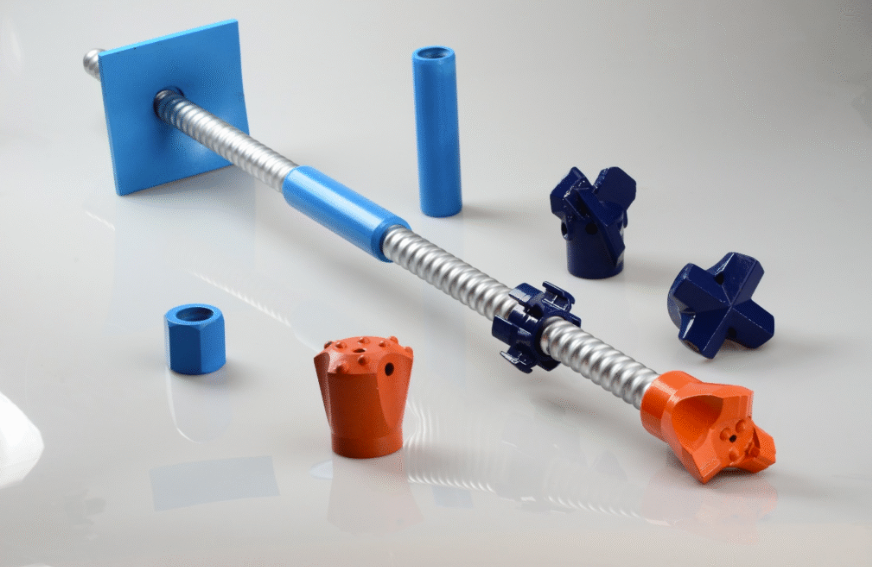
The performance of a hollow bar system is not determined by the bar alone. The drilling bit, coupling arrangements, drilling equipment, grout system, and installation parameters all form part of the working assembly.
The drilling bit must be appropriate for the material being penetrated. Different geological conditions may require different bit designs and drilling approaches.
Similarly, the connection between individual bar sections needs to maintain the required mechanical integrity throughout installation. These details demonstrate why anchor systems should be treated as complete engineered assemblies rather than individual steel products.
Grouting as Part of the Installation Strategy
Once the anchor has reached the required depth, grouting can establish the connection between the reinforcement and the surrounding ground.
The grout travels through the hollow interior and can emerge near the drilling end. Depending on the ground conditions and installation method, this allows grout to occupy the surrounding space and develop the bond required by the design.
The process requires appropriate control because grout properties and placement can influence the final anchoring behavior. Mixing, pumping, pressure, volume, and curing all need to be considered within the project’s quality-control procedures.
Temporary Support and Permanent Applications
Not every ground reinforcement system serves the same purpose. Some anchors are installed to provide support during a particular construction phase, while others are designed to remain in service for many years.
This distinction affects material selection, corrosion protection, testing, installation quality, and design criteria. A temporary system may have different durability requirements from an anchor that forms part of a permanent retaining or stabilization structure.
For permanent applications, engineers need to consider the surrounding environment and expected service conditions when selecting the steel, grout, protective measures, and installation procedure.
Why Installation Records Matter
Ground reinforcement becomes part of a structure or stabilized ground mass, so documentation of the installation process can be valuable for quality assurance.
Records may include drilling depth, drilling behavior, grout consumption, installation parameters, anchor dimensions, and testing information. Such records can help engineers compare actual installation conditions with the original design assumptions.
They can also provide useful information if unexpected geological conditions are encountered during construction. Instead of relying solely on assumptions made before excavation began, project teams can use installation data to understand what was actually encountered underground.
The Relationship Between Engineering and Construction
The most effective reinforcement systems are not selected in isolation. Engineers need to understand how the proposed technology will interact with the construction process.
A system may have excellent technical characteristics but still be unsuitable if the required drilling equipment cannot access the work area. Likewise, a convenient installation method may not satisfy the required load capacity or durability criteria.
This is why project planning should consider structural requirements, geology, equipment, access, installation sequence, testing, and long-term service conditions together.
Looking at Ground Reinforcement as a Complete Process
Modern geotechnical construction increasingly focuses on the complete lifecycle of reinforcement rather than simply the final installed component.
The process begins with geological investigation and design. It continues through equipment selection, drilling, reinforcement installation, grouting, testing, and quality control. Finally, monitoring may be required to confirm that the stabilized ground continues to behave as expected.
Within this wider process, hollow bar technology provides one method for connecting drilling and reinforcement activities. Its usefulness depends on how well it fits the specific conditions and objectives of the project.
Conclusion
Difficult ground conditions often require more than stronger materials. They require installation methods that can work with the realities of the construction environment. Limited access, unstable formations, changing geology, and complicated site logistics can all influence the choice of reinforcement technology.
A hollow anchor bar can address some of these challenges by combining drilling and reinforcement functions within a coordinated system. Its hollow interior can also support grout delivery, allowing the installation process to progress without relying entirely on a separate open-borehole procedure.
The technology is not a universal replacement for traditional anchoring methods. Its value depends on proper engineering assessment, suitable equipment, appropriate materials, controlled grouting, and careful installation. When those elements are brought together, hollow bar systems can provide construction teams with another practical option for managing demanding ground reinforcement projects.
FAQs
What is a hollow anchor bar used for?
It is used as part of ground reinforcement systems for applications such as slope stabilization, tunneling, retaining structures, foundations, and other geotechnical works.
How does the hollow design help during installation?
The internal passage can provide a route for grout or other drilling materials, allowing drilling and grouting activities to be integrated into the installation process.
Why can hollow bar systems be useful on restricted sites?
They can be paired with suitable drilling equipment and may reduce the number of separate installation stages required, which can be useful where working space is limited.
Are hollow bars suitable for changing ground conditions?
Certain systems are designed for difficult or variable formations, particularly where maintaining an open borehole during conventional installation could be problematic.
What factors affect anchor performance?
Ground conditions, anchor dimensions, drilling quality, grout properties, installation parameters, corrosion protection, and engineering design can all influence performance.
Can hollow bar anchors remain underground permanently?
Some systems can be designed for permanent applications, provided the materials, protection, installation quality, and project design satisfy the required long-term conditions.