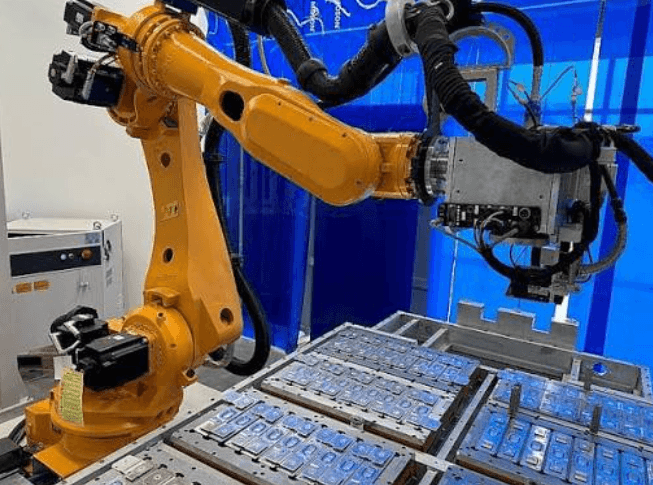
Industrial production becomes increasingly challenging when a single component requires several different operations, orientations, or tool approaches. A part may need to be rotated, inspected, welded, trimmed, polished, or assembled from multiple angles, creating difficulties for equipment designed around simple linear movement. A 5 axis robot can address some of these challenges by coordinating movement across several axes, giving the tool or workpiece greater freedom to change position and orientation during a programmed task. This capability can make complex operations easier to automate while helping manufacturers reduce repeated manual repositioning.
The usefulness of multi-axis robotics extends beyond difficult shapes. Modern production environments often need to handle product variations, shorter production runs, customized components, and frequent changes in manufacturing requirements. A programmable robotic system can potentially adapt to these conditions through new motion programs, fixtures, or tools instead of requiring an entirely different machine for every task. That flexibility can be valuable for manufacturers seeking to improve automation without making every production process completely dedicated to one product.
Still, flexibility should not be confused with automatic success. A robot needs to be correctly matched with the workpiece, tooling, fixtures, control system, workspace, and production requirements. Its movement must be programmed carefully, and the entire cell must be designed around safe operation. When these factors are addressed together, multi-axis robotic movement can become a practical way to improve repeatability and expand the range of processes that can be automated.
Complex Workpieces Demand Greater Freedom of Movement
Manufactured components are often more complicated than their basic dimensions suggest. Curved surfaces, angled sections, recessed areas, irregular edges, and multiple working faces can make conventional automation difficult. A tool that approaches from one fixed direction may reach some areas easily while being unable to access others.
Multiple coordinated axes allow the robotic system to alter the position and orientation of the tool as the process progresses. This can reduce the need to stop production and reposition the workpiece manually. For operations that require consistent contact or alignment, maintaining the correct tool angle throughout a programmed path can also improve process uniformity.
The actual geometry still determines what is possible. Narrow openings, deep cavities, and obstructed surfaces can create limitations even when a robot has considerable movement capability. Simulation and process planning can help identify these restrictions before the equipment is committed to production.
Flexibility Begins With Programmable Movement
A major advantage of industrial robotics is that movement can be programmed rather than mechanically fixed. Instead of performing one repetitive motion, the robot can follow different sequences depending on the product or task.
This can be particularly useful in facilities producing several variations of a component. A new program may allow the same robotic platform to perform a different sequence, while a new fixture or end effector can expand the range of operations. Programming does not eliminate setup time, but it can provide manufacturers with more flexibility than equipment designed around a single unchanging movement.
Where Multi-Axis Systems Fit Into Industrial Production
Multi-axis robotic systems can be applied across many different processes.
- Component positioning: Parts can be rotated and presented at suitable angles for downstream operations.
- Welding: The tool can approach joints from different orientations.
- Surface treatment: Robotic movement can follow curved or irregular surfaces.
- Cutting and trimming: Programmed paths can follow complex component profiles.
- Inspection: Sensors and cameras can reach different faces and features.
- Assembly: Components can be aligned from several directions during automated operations.
- Material handling: Parts can be picked, rotated, and transferred according to a programmed sequence.
- Dispensing: Adhesives, sealants, or similar materials can be applied along controlled paths.
The same robot may be capable of several of these functions, but the tooling and configuration will determine which applications are practical. Payload, reach, speed, environmental conditions, and required precision should all be reviewed before choosing the system.
Tooling Determines What the Robot Can Actually Do
A robotic arm provides movement, but the end effector performs the physical operation. A gripper can handle components, a welding tool can join materials, a cutting head can remove material, and a sensor can inspect a surface. This means tooling selection is closely connected to robot selection.
Tool weight and dimensions can affect the available payload and working range. A large tool may also require additional clearance around the component. If a production process involves changing tools, the time and method required for those changes should be considered as part of the workflow. A flexible robot becomes much more useful when its tooling strategy is equally well planned.
Fixtures Create a Stable Reference Point
Robotic programs are based on known positions. If a component is not located where the system expects it to be, even an accurately programmed movement may miss the intended target.
Fixtures help create repeatable positioning by holding workpieces securely in predetermined locations. Their design needs to balance stability with accessibility. The robot must be able to reach the required surfaces without the fixture blocking the tool path.
For manufacturers handling multiple products, adaptable fixtures may provide additional flexibility. However, every new configuration still needs to be validated to ensure that the robot’s programmed movements correspond correctly with the physical position of the workpiece.
Motion Planning Can Influence Cycle Time
A robotic process can often complete the same task through several different movement paths. Some paths may contain unnecessary rotations or travel, while others may create smoother and more efficient motion.
Optimizing the path can reduce cycle time without changing the actual manufacturing operation. Engineers can evaluate where the robot needs to accelerate, slow down, rotate, or reposition and remove unnecessary movements where possible. Over thousands of production cycles, these small improvements can have a noticeable effect on total output.
Precision Depends on the Entire Robotic Cell
The robot itself is only one element of positional accuracy. Fixtures, tools, sensors, programming, calibration, workpiece variation, and environmental conditions can all influence where the tool actually operates.
Regular calibration helps maintain the relationship between programmed coordinates and the physical workspace. Tool changes may also require updated reference information. Monitoring the complete system makes it easier to identify whether a quality problem originates from the robot, fixture, tooling, programming, or another part of the production cell.
Production Flexibility Can Reduce Equipment Constraints
Manufacturers increasingly need to respond to changing orders and product variations. A production line designed exclusively for one component may become difficult to justify when demand changes or new products are introduced.
A programmable multi-axis robot can provide an alternative approach. By modifying programs and, where necessary, changing fixtures or tools, the same basic robotic platform may support different operations. This can make automation more adaptable, particularly for facilities that produce several related components rather than enormous volumes of one identical item.
Safety Needs to Account for the Complete Working Envelope
Greater movement capability also creates a larger area that must be considered from a safety perspective. The robot, tooling, workpiece, and surrounding equipment can all move or interact within the cell.
Safety measures should therefore be designed around the complete operation. Depending on the application, this may involve guarding, interlocked access points, safety scanners, emergency-stop systems, controlled operating modes, and clearly defined maintenance procedures. The appropriate safeguards depend on the specific installation and applicable requirements.
Maintenance Keeps Multi-Axis Movement Reliable
Robotic systems contain motors, joints, drives, cables, sensors, controllers, and tooling that must work together consistently. Wear in one component can gradually affect positioning or movement quality even when the robot continues operating.
Preventive maintenance provides an opportunity to identify such issues before they cause significant downtime. Maintenance programs should include inspection of the robotic arm as well as the tooling, fixtures, cables, sensors, and safety equipment connected to the cell. Keeping accurate service records can also help identify recurring problems and improve maintenance planning.
Skilled Personnel Remain Essential
Robotics can automate physical movement, but technical knowledge remains necessary throughout the system’s life. Programmers develop motion sequences, operators monitor production, engineers optimize processes, and maintenance teams keep the equipment functioning correctly.
Human expertise is especially valuable during commissioning and process improvement. A theoretical motion path may need adjustment after testing reveals an unexpected collision risk, tool-access problem, or inefficient movement. Experienced personnel can refine the system so that the robot performs its task more effectively without compromising safety or quality.
See also: Friend of Bus Singapore: Reliable Private Bus Charter Services
Final Thoughts
Multi-axis robotic movement provides manufacturers with greater freedom to approach complex workpieces, change tool orientation, and automate processes that would otherwise require repeated manual repositioning. Its value is particularly clear when products have difficult geometries or when production requires flexibility between different components and operations. The technology can support applications ranging from welding and cutting to inspection, finishing, assembly, and material handling.
A properly planned 5 axis robot should therefore be evaluated as part of a complete manufacturing cell rather than as an isolated piece of equipment. Tooling, fixtures, programming, calibration, safety, maintenance, and operator expertise all contribute to its performance. When these elements are designed around the actual production requirements, five-axis robotic movement can provide a flexible foundation for more consistent and adaptable industrial workflows.